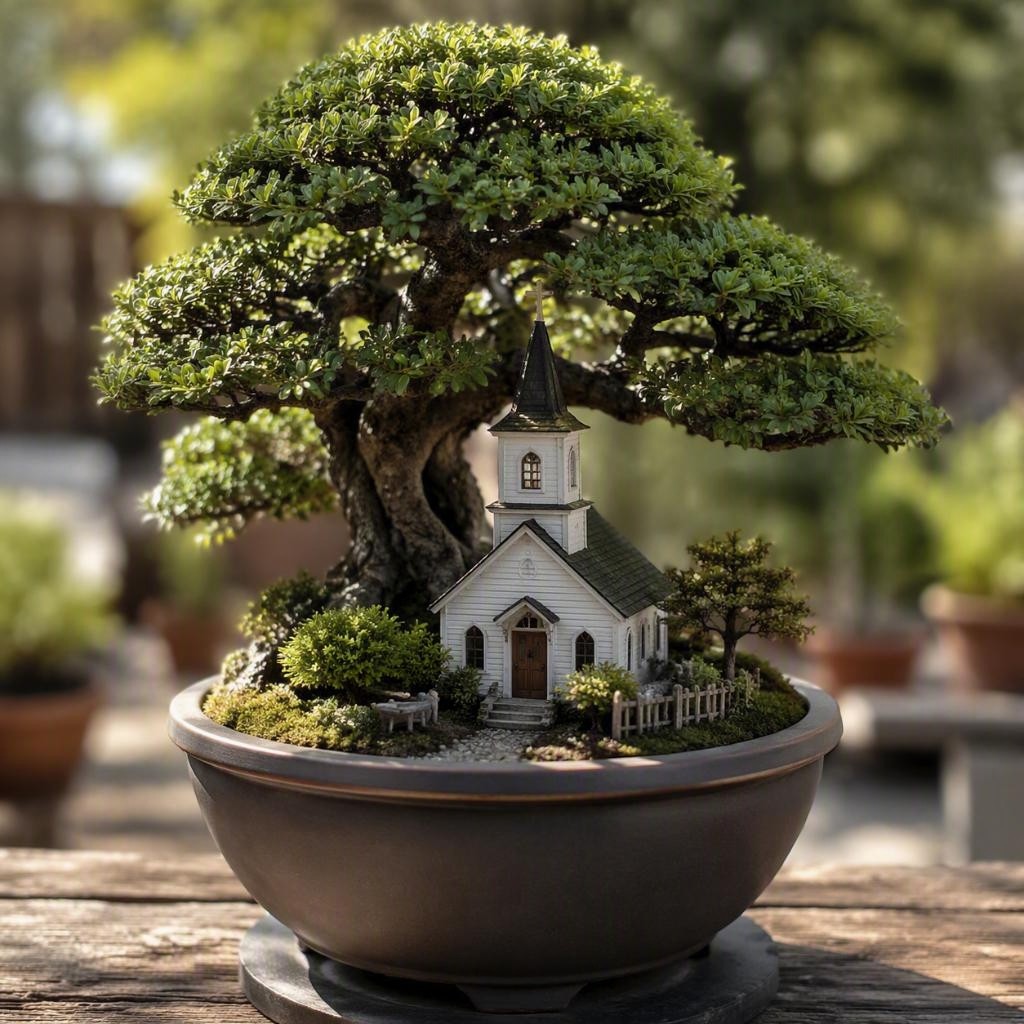
This is an AI generated image of a bonsai church.
Steve Dresselhaus, July 2026
Bonsai trees are cute miniature creations that, against their nature, are shaped by the gardener’s vision for them. The gardener/artist snips, cuts and repots till he creates what he wants. As cute as they are, this manipulation denies them the freedom to grow into what they were originally designed to be. Bonsai trees are real—but are only a fraction of what they could have become.
In a similar way churches shaped by tradition and human systems, have often become a form of ecclesiastical bonsai. For nearly 17 centuries—since Constantine institutionalized the Body of Christ by incarcerating in cages we call church buildings—we have structured churches to the point that many are only a fraction of what they could have been.* Some are large in membership, but they remain “bonsai” because they reflect human design more than clear biblical precedent.
Many church leaders, though well-intentioned, unknowingly propagate and sustain this system. It is not their fault; they inherited it, were trained in it, and often know no alternative. Tradition, inertia, and existing infrastructure make change difficult, though not impossible.
“Bonsaification” often begins when a fellowship views itself as a stand-alone organization and adopts a name. Naming a church is probably not wrong, but the Bible offers no explicit precedent for it. With a name comes structure—both physical and programmatic—that must be maintained. Each step toward unique identity—whether naming a church or joining a denomination—can subtly reinforce separation: and isolation – “We are this, and you are not.”
The group I gather with calls itself “the Patio.” Yes, we use a name, but we encourage people to engage with other gatherings of believers and to remember that we are only a small part of the greater Body of Christ. We do not promote “church shopping,” and we affirm the importance of belonging to a local fellowship where spiritual gifts can be identified and developed for the furtherance of Christ’s body. We want more and more people to worship with us, but we need them to know that we are just a tiny part of the Body of Christ and that their primary allegiance is to King Jesus, not to the Patio.
Many elements commonly found in modern churches may be useful, but when they begin to define or control ministry, they promote “bonsai.” These include dedicated buildings, denominational structures, course-based discipleship, professionalized worship, program-driven ministries, performance-focused services, elevated platforms, and an overemphasis on sermons by one person per church. Other bonsai tools are manipulative worship, mood control techniques, dim lighting in a low light sanctuary, and probably a whole lot more. When these features shape the church more than biblical principles do, growth can be constrained; growth can be limited to what bonsai allows.
I once proposed an outreach to underserved children near a church I attended. Though the idea was welcomed by the congregation, it was ultimately rejected due to insurance concerns. It raises an important question: how is it possible for an insurance company to control the mission of the church? How loudly can you scream BONSAI?
If people gather with us in the Patio, I hope it is because of Christlike character—not music, programs, or presentation. Are we obedient to Jesus? Do we love one another? Do we share with others and devote ourselves to the apostles’ teaching? These are the marks that matter.
Few would deny that many traditional churches are declining, and the trend continues and appears to be snowballing. History shows that large institutional expressions of Christianity often rise only to ultimately fall—examples being North Africa, Asia Minor, Europe, and now North America. While some traditional churches will continue to shine, many, probably most, will fade. Yet the true Church—the Body of Christ—does not decline. It endures and often thrives, but in simpler, more relationship focused forms.
So how do we escape the “bonsai” system? It is not as complicated as it may seem. Step one is to recognize that the Bible does not define church; instead, it offers principles, examples and descriptions. Leadership qualifications emphasize character over credentials. Roles are described, but methods are not prescribed in detail. This promotes tremendous flexibility in “how?” and “where?” believers gather and live out their faith. Before answering the “how?” and “where?” question, however, we need to invest time in answering the more important question, “Why?” Only after answering the “why?” question should we begin to explore the “how” and “where” questions. Unfortunately, we tend to launch our churches with the “how” question and thus start out with church bonsai.
The church is not a system to manage. It is a way of life to live. We need to change the word church from a noun to a verb. Formal and informal gatherings, different settings, and diverse practices can all reflect a faithful community. In contrast, “bonsai” churches prioritize control and conformity.
As church communities grow, there is a natural temptation to add programs and complexity. Churches slide into compliance with the Law of Unsustainable Complexity which states that organizations increase in complexity to the point where more time and energy are expended in maintaining the organization than in fulfilling the purpose of the organization. When maintaining the system becomes the primary focus, the original purpose is lost, maybe not on paper, but in action, yes.
I once heard a church leader say, “If we’re going to meet our budget, we need more people.” That was a telling moment—snip, snip, trim, trim. That was the straw that broke the camel’s back. That was the turning point in my ministry when I really began to search for and promote the Body of Christ and to no longer pursue the status quo of traditional church ministry.
I will never in a million years turn against the traditional churches in their current system. They are, after all, the majority in the current visible expression of the Body of Christ. Regardless of her flaws and weaknesses she is still the most beautiful organization on the planet. I just want to help her burst out of the bonsai pot in which she finds herself right now so that she can grow to be what King Jesus wants her to be.
*There are still many, many wonderful traditional churches, and I am very grateful and indebted to them. The good they have done by serving the world is huge beyond measure. However, it would appear that the traditional church’s days are numbered. The body of Christ will endure and thrive; it just is not likely to be in the format we currently see.

